Ancestry DNA Haplogroups
Right now, haplogroups are the only way to trace your family tree back to the time before surnames were invented.
At its essence, a haplogroup is an ancestral clan. Some clans are the Vikings, Native Americans (all tribes), Celts, Aborignal Australians, and other such groups. Your haplogroup tells you where your ancestors came from deep back in time.
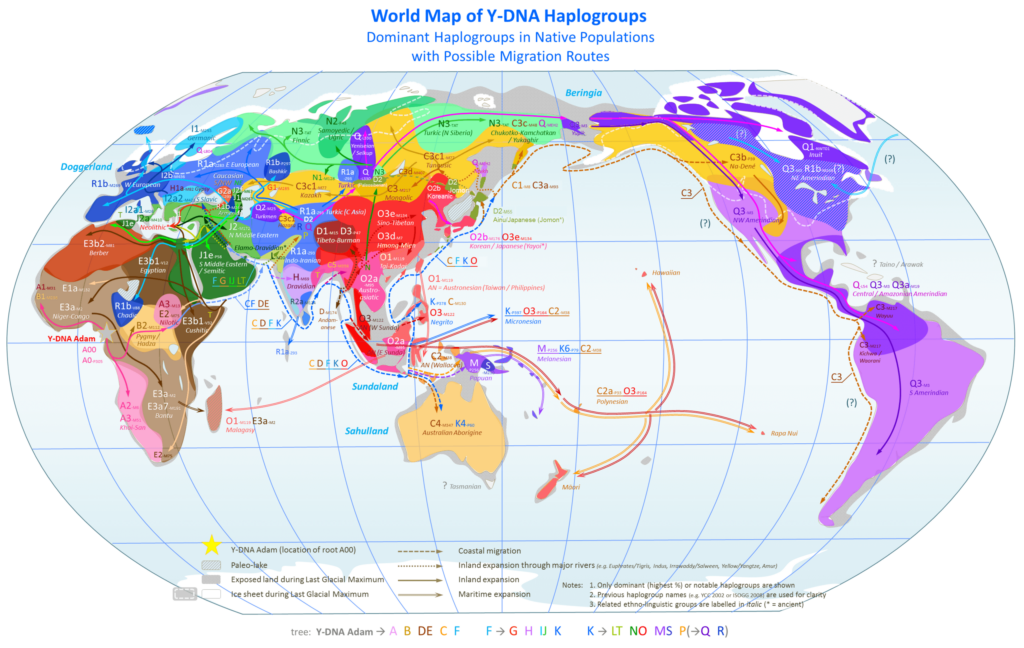
In humans, haplogroups can either be based on Y-DNA which is passed from father to son or mtDNA which is passed from mother to offspring of both sexes. So, there are male and female haplogroups. You can see where your male and female sides of the family originated back in pre-historic times. As with Y-DNA (which traces the male line from father to son) and mtDNA (which traces the female line from mother to daughter), haplogroups also follow straight male and female descendancy lines.
Initially, there was only one haplogroup, and it was in Africa. As African tribes moved off the continent and went to various other places on the planet, their DNA mutated and the number of haplogroups increased. New haplogroups are formed even today, when a gene mutation occurs in someone from a particular ancestral clan. However, it takes generations for enough people to carry the mutation for it to be prevalent enough for it to be considered a haplogroup. Therefore, any haplogroups that start forming today will not be recognized as new ones for centuries, or even millennia. The haplogroups that form today will eventually be able to be traced back to the earliest known person to carry the mutation, just as today’s known haplogroups can be traced back to the earliest known person to carry it in the distant past (though we don’t know the names of these people, we do know they existed and approximately where they lived and when).
Just as new haplogroups are being formed today, many have died out over the course of human history. The haplogroups that exist today originated with people whose descendants were very successful at reproducing in large families.
Haplogroups today are divided into four main ones: European, African, Native American, and Asian. Within these haplogroups are many sub-haplogroups that further define where a person’s earliest known non-African ancestor on the male and female sides of their family originated and when. Most haplogroup sub-groups are plentiful. The only group with less than three sub-groups is the Native American male group, which only has two sub-groups.
Basically, haplogroups chart the clans from which the modern human race originated. Haplogroups are names alphabetically in order of discovery. So don’t assume a haplogroup of A means African or E is European, because this is not true. The sub-groups of haplogroups are named with letter and number combinations indicating where and when in time they were discovered, which main haplogroup they descend from, and sometimes even the very specific small geographical area where their earliest members lived.
The more letters and numbers in your haplogroup’s sub-group, the more likely you are to be able to pinpoint an exact region, and maybe even a county or town. Some haplogroup sub-groups can even be traced back to named individuals if the mutation that created them originated in the more recent past. For example, the infamous Celt, Niall of the Nine Hostages, is known to be the originator of a sub-group of a haplogroup within the past 1500 years, and some people can use their sub-group to prove their descent from him. However, haplogroups are not normally used to prove descent from any one person, just to show you where your “out of Africa” ancestors originated and when.
You can take your last known ancestor in a particular direct male or direct female line and connect them to a larger clan in the more distant past, knowing that their ancestors, the ones you can’t identify and trace, wound back through time to the time and place where the known ancestor’s haplogroup and sub-group originated.”*
* Above information on Haplogroups extracted from www.ancestralfindings.com.
Panek Haplogroup R1b1b2a1a1d1
Paternal Line
DNA analysis has identified the Panek paternal lineage to the haplogroup R1b1b2a1a1d1* which is a subgroup of R1b1b2. R1b1b2 is the most common haplogroup in western Europe, where its branches are clustered in various national populations. R1b1b2a1a2b is characteristic of the Basque, while R1b1b2a1a2f2 reaches its peak in Ireland and R1b1b2a1a1 is most commonly found on the fringes of the North Sea. The simple take away from this is that our ancestors migratory beginnings likely trace back to Northern Europe and as stated above the fringes of the North Sea.
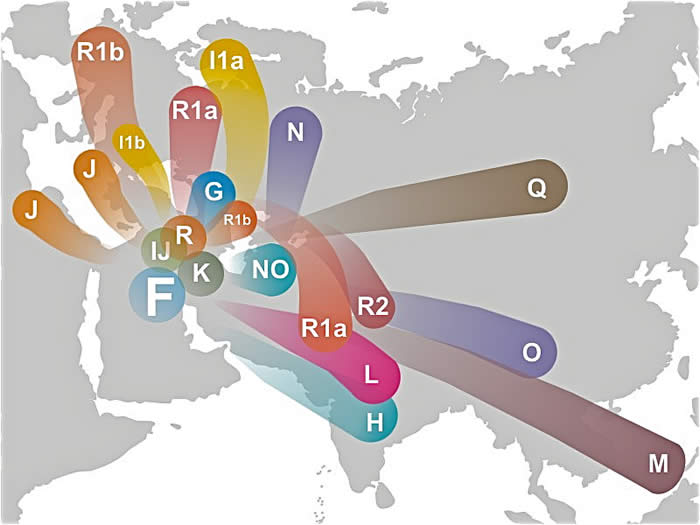
The map shows the geographical migration of Haplogroups out of Africa.
Paternal Line
Because of recent immigration, both branches of R are now found worldwide among men of European, Middle-Eastern and South Asian descent though our haplogroup maps indicate only their pre-colonial distributions.
Haplogroup R1 R1 is the dominant haplogroup in Europe today, accounting for well over half of all men. After being confined to the continent’s southern fringes during the Ice Age, it expanded rapidly in the wake of the receding glaciers about 12,000 years ago. Various branches of R1 also trace the many migrations that have shaped Europe since then, from the arrival of farmers between about 10,000 and 7,000 years ago to the movements of ethnic groups such as the Anglo-Saxons and Vikings.
Haplogroup R1b Haplogroup R1b was confined during the Ice Age to pockets of territory in Mediterranean Europe. The largest was in the Iberian peninsula and southern France, where men bearing the haplogroup created the famous cave paintings at Lascaux and Altamira. They also hunted mammoth, bison and other large game in a climate that was more like present-day Siberia’s than the mild conditions prevailing in southern Europe today.
Some men bearing R1b Y-chromosomes also seem to have spent the Ice Age in the Balkans and Anatolia, where the haplogroup is still present today. After the Ice Age, the haplogroup expanded rapidly in the wake of the retreating glaciers.
Today R1b is by far the most common haplogroup in the western half of the continent. Haplogroup R1b1b2 R1b1b2 is the most common haplogroup in western Europe, where it is found in more than 50% of men. Ancient representatives of the haplogroup were among the first people to repopulate the western part of Europe after the Ice Age ended about 12,000 years ago. In the process the haplogroup differentiated into even more distinct groups that can trace the details of the post-Ice Age migrations.
Haplogroup R1b1b2a1a2b arose about 20,000 years ago, when the Ice Age was at its peak. It appears to have originated among the ancestors of the present-day Basque, because of the relatively high diversity of the haplogroup in that population compared to neighboring ones. Today R1b1b2a1a2b is found in about 5% of Basque and 1% of Iberians.
Haplogroup R1b1b2a1a2f2 reaches its peak in Ireland, where the vast majority of men carry Y-chromosomes belonging to the haplogroup . Researchers have recently discovered that a large subset of men assigned to the haplogroup may be direct male descendants of an Irish king who ruled during the 4th and early 5th centuries. According to Irish history, a king named Niall of the Nine Hostages established the Ui Neill dynasty that ruled the island country for the next millennium.Northwestern Ireland is said to have been the core of Niall’s kingdom; and that is exactly where men bearing the genetic signature associated with him are most common. About 17% of men in northwestern Ireland have Y-chromosomes that are exact matches to the signature, and another few percent vary from it only slightly. In New York City, a magnet for Irish immigrants during the 19th and early 20th century, 2% of men have Y-chromosomes matching the Ui Neill signature. Genetic analysis suggests that all these men share a common ancestor who lived about 1,700 years ago. Among men living in northwestern Ireland today that date is closer to 1,000 years ago. Those dates neatly bracket the era when Niall is supposed to have reigned.Outside Ireland, R1b1b2a1a2f2 is relatively common only along the west coast of Britain.
Haplogroup R1b1b2a1a1 Today is found mostly on the fringes of the North Sea in England, Germany and the Netherlands, where it reaches levels of one-third. That distribution suggests that some of the first men to bear the haplogroup in their Y-chromosomes were residents of Doggerland, a real-life Atlantis that was swallowed up by rising seas in the millennia following the Ice Age. Doggerland was a low-lying region of forests and wetlands that must have been rich in game; today, fishing trawlers in the North Sea occasionally dredge up the bones and tusks of the mastodons that roamed there. Doggerland had its heyday between about 12,000 years ago, when the Ice Age climate began to ameliorate, and 9,000 years ago, when the meltwaters of the gradually retreating glaciers caused sea levels to rise, drowning the hunter’s paradise. Doggerland’s inhabitants retreated to the higher ground that is now the North Sea coast.
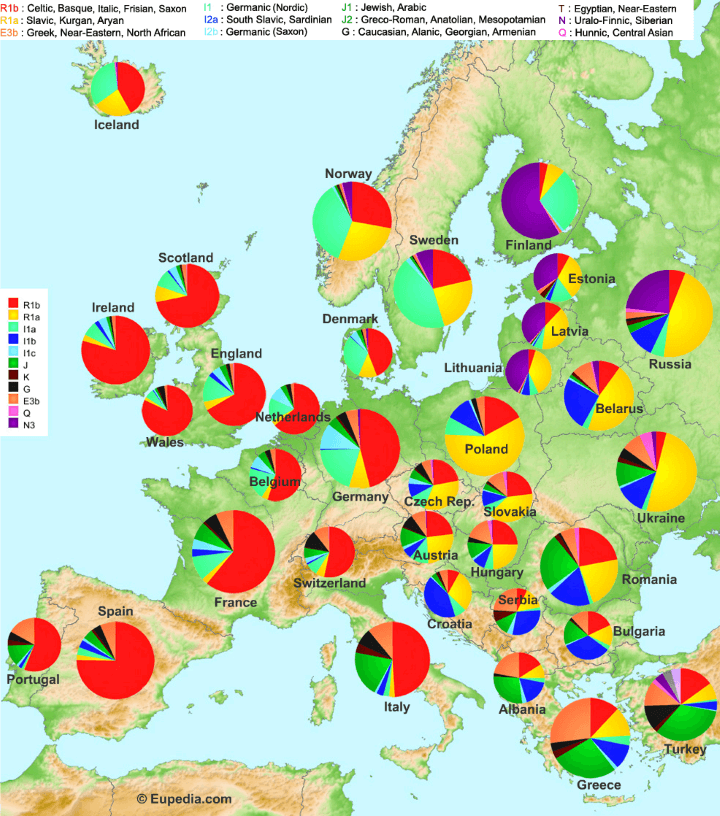
The following map shows R1b’s more common distibution throughout Scotland, Ireland, England France, Spain and Italy.
Panek Haplogroup Kb1b1a
Maternal Line – Ashkenazi Lineage
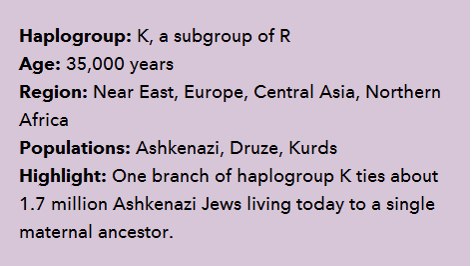
DNA analysis has identified the Panek maternal lineage to the haplogroup K branched off haplogroup U8 about 35,000 years ago. It continues to have a strong presence in the region today, reaching levels of 20% among Druze Muslims and about 10% among Kurds, Palestinians and Yemenites. It is also found among the Gurage of Ethiopia, who are thought to be descended from Arabian invaders.
Maternal Line – Ashkenazi Lineage
K spread from the Near East into Europe about 15,000 to 12,000 years ago, as the Ice Age was ending and temperate forests spread over the previously frigid continent. It is still found at low levels in most European populations, where many branches of the haplogroup match identical ones from the Near East. That close similarity suggests that more recent migrations also may have carried haplogroup K from the Near East to Europe, perhaps in conjunction with the spread of agriculture about 8,000 years ago.
Haplogroup K also extends into Central Asia as far as the Altay Mountains, a range that runs along the western edge of Mongolia’s Gobi Desert. It may have reached there with relatively ancient migrants from the Near East, and then been spread to other parts of Asia during the medieval expansion of the Turkic peoples to the Urals and modern-day Turkey.
Altogether there are dozens of unique branches within this haplogroup, including some of unknown distribution. However, a few populations carry branches of haplogroup K that have been extensively characterized.
The Ancient Basques Geneticists have taken a great interest in the Basques of far northern Spain because of their unusual language, which suggests they descend from some of the original settlers who arrived in southwestern Europe during and after the Ice Age. Though haplogroup K is relatively rare among the Basques today, mitochondrial DNA extracted from prehistoric burials suggests it was much more common in the past. In remains excavated from three cemeteries dating to between 4,000 and 5,000 years ago, haplogroup K showed up at levels of 17 to 24%. A similar sample from a medieval Basque cemetery found that by around 1,500 years ago the haplogroup’s levels had fallen to its present-day level of about 4%.
What could account for this near-disappearance of haplogroup K among the Basque? It could be that female migrants to the region married into the Basque population, swamping out the K lineages with their own haplogroups. Or it could be that the Basque population experienced a crash at some time in the past that disproportionately eliminated haplogroup K from the gene pool.
K in the Ashkenazi A few branches of haplogroup K, such as K1a9, K2a2a, and K1a1b1a, are specific to Jewish populations and especially to Ashkenazi Jews, whose roots lie in central and eastern Europe. These branches of haplogroup K are found at levels of 30% among Ashkenazi. But they are also found at lower levels in Jewish populations from the Near East and Africa, and among Sephardic Jews who trace their roots to medieval Spain. That indicates an origin of those K haplogroup branches in the Near East before 70 AD, when the Roman destruction of Jerusalem scattered the Jewish people around the Mediterranean and beyond.
About 1.7 million Ashkenazi living today – about 20% of the population – share a single branch of the K haplogroup, K1a1b1a. The diversity of that haplogroup among Ashkenazi suggests that it arose in the Near East between 2,000 and 3,000 years ago, and that everyone who shares it today could have shared a common ancestor as recently as 700 years ago. A similar pattern in two other K branches that are common among the Ashkenazi, K1a9 and K2a2, as well as the N1b branch of haplogroup N, has led researchers to conclude that 40% of the Ashkenazi living today – about 3.4 million people – could descend from as few as four women who lived within the last 2,000 years.
Historical information supports that conclusion. The Ashkenazi tradition traces back to a small number of people who migrated from northern Italy to the Rhine Valley of Germany around 700 AD, then grew over the next 1,300 years to a population of more than 5 million.
Unraveling the Panek Ancestral Tapestry
This section highlights a curated collection of images showcasing the beauty and essence of your offerings.